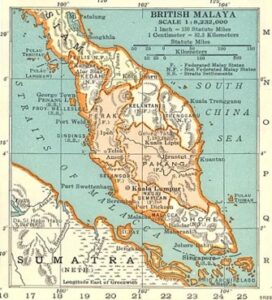

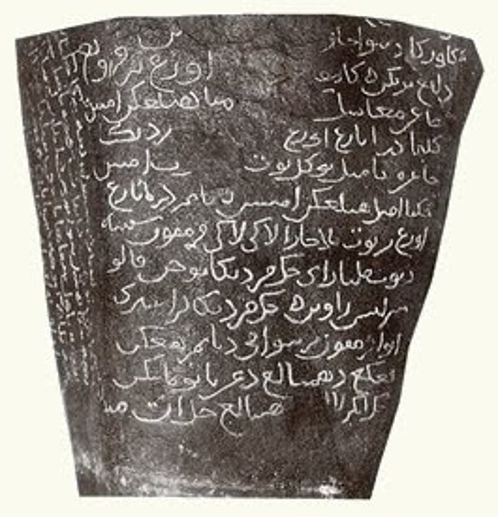
This chiseled stone is probably the first Jawi inscription found in Peninsular Malaysia, dating to 1303 A.D.
It is a four-side granite stone of irregular shape engraved with religious texts in all four sides, 90 x 53 cm in size and weighting about 220 kgs. It was first discovered in Kuala Berang in 1887 by local villagers.
The said inscriptions are in Classical Malay written in the Jawi script, with Arabic script (ب ، ت ، ج ، ش ، ق ، ن ، ي ) and native Jawi letters ( چ ، ݢ ، ڠ ، ڤ ,ڽ ، ض ، ف ).
The letter ڽ (nya), or Nun with three clustered dots, is carefully crafted in the stone and the most visible of all. It is maybe one of the most significant letters, not found in Arabic or any other language using Kufic/Arab alphabet in their languages.
This archeological finding caused quite a stir in academic circles, as it debunked the prevalent opinion at the time that Islam was first adopted in Malay Peninsula by the inhabitants of the western shores on the Indian Ocean, spreading eastwards and that it arrived from the Arabian Peninsula via India and Aceh. Current academic opinion now sustains that both shores received early Islamic influences about the same time.
The content of the engraved text has been partially translated, as many parts of the inscription are illegible nowadays. Here is a reproduction of one of the texts in Jawi or Classical Malay, with its corresponding English translation.
| رسول الله دعں ىع اورح سىاىى مرٮک | Behold the Prophet of God and his apostles. |
| اسا فدا دىوٮ ملىا راى ٮرى همٮا مںكهكں اكاما اسلام | Praise the God Almighty for giving us Islam. |
| دعں ٮٮر ٮحارا درما مرٮک مرٯسا ٮكى سكلںں همىا دىوٮ ملىا راى | With Islam, truth revealed to all Thy creatures |
دٮٮواكو اٮى ٯٮٮٮو أكاما رسول الله صلى الله علىه وسلم راحا | On this land the religion of the Holy Prophet shall prevail. |
| مٮدلٮكا ٮع ٮٮر ٮحارا سٮله دٮوٮ ملٮا راى ددالم | The Holy Prophet, the upholder of truth in Thy kingdom. |
| ٮهومى. ٯٮٮٮوں اٮٮو ٯرض فدا سكلںں راحا مںدا | Hear ye kings, these messages. |
| لںكا اسلام مںورٮ سٮٮٮه دٮوٮ ملٮا راى دعں ںںر | Messages from the Almighty, ye doubt not. |
| ںحارا ںرںاحںكى ںںوا ٯٮٮٮوں اٮٮو مک ٮٮٮه سرى ٯادوكا | Goodwill, with thee fellow men, saith the Almighty. |
| ںهں مدودوٯكى ںامرا اٮى دٮٮوا ٮرعكاٮو اد ٯرٮاما ادا | Be it known, the land of Terengganu, the first to receive message of Islam. |
| حمعه دںولں رحٮ دٮاهں سرطاں دسسںكلا | On the noon on Friday in the month of Rajab whilst the sun was in the north by religious reckoning. |
| ںكںدا رسول الله ںله لالو ںوحه راںس دوا | Seven hundred and two years after the demise of the Holy Prophet. |
Here is a comparative chart of some Jawi words as found in Batu Bersurat and as spelled in Modern Standard Jawi (MSJ).
Note the absence of “harakat” (Arabic vowel sounds) and most of “nuqat” (punctuation in consonants) in the ancient script, as opposed to modern Jawi script
| مٮورٮ | menurut | according to | منوروت |
| ٮوٮ | buat | do | بوات |
| داٯٮ | dapat | get | داڤت |
| حمعه | Jumaat | Friday | جمعة |
Today, Jawi is co-official script in many ASEAN countries, namely:
- Brunei
- Malaysia (Regional):
- Indonesia
- Philippines (Bangsamoro)
- Thailand (Pattani, Yala, Narathiwat)
- Myanmar
- Vietnam (Champa)
Reading Jawi scripts reminds you of “Aljamiado”/ A’jamii / اعجمي
What is Aljamiado?
Aljamiado’s origins (pronounced ”alkhamiado”) can be traced to X century Al-Andalus, when the Iberian Peninsula was part of Islam and where Christians or Mozarabs, who spoke romance languages, lived alongside Arabic-speaking Muslims and Jewish communities. With the passing of time, linguistic and cultural interaction produced hybrid literary traditions in which some Romance languages were written using Arabic script. Jewish merchants would write to one another using Hebrew language written in Aljamiado, a sort of medieval encryption.
After the fall of Granada in 1492, the use of Arabic language became restricted and eventually was criminalized by the Emperor Felipe II in 1567, so Aljamiado became a sort of subversive language for Muslims, a clandestine way to cling on their identity for a few more generations.
One important difference is that, unlike Jawi, Aljamiado is no longer in use, even in north Africa. It is a dead language.
Another important difference is that Jawi has created its own consonants, as shown above; in ancient Aljamiado there isn’t any additional letter not found in Arabic alphabet.
Here is a sample of a book on botany, dating back to the X century, written in the Aljamiado script
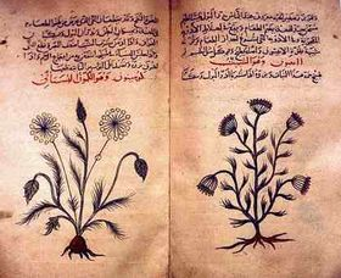
What is striking is the fact that, while the Arabic script was being introduced in Peninsula Malaya, at the same time it was gradually disappearing from the Iberian Peninsula
Jawi emerged as the Malay Peninsula and archipelago Islamized, gaining momentum with the rise of Melaka as a Muslim trading entrepot. Crucially, Jawi was the script of an Islamic civilization in full expansion: it became the chancery script of sultanates, the medium of law codes, royal correspondence, historiography (the Sejarah Melayu or Malay Annals), and religious/legal commentary. It was public, prestigious, and state-sponsored — the visible marker of a Malay world defining itself as part of the wider Islamic civilization\
Aljamiado was almost the mirror image, both in form and in fate. It denotes Romance vernaculars — Old Spanish, Aragonese, sometimes Portuguese — written in Arabic script. Unlike Jawi, Aljamiado wasn’t the script of a rising polity but of a defeated and increasingly persecuted minority. After Granada fell in 1492 and forced conversions followed, spoken and especially written Arabic became politically dangerous and was formally banned. Moriscos, the vanquished of the Reconquista who had lost fluency in Arabic but wanted to preserve devotional and communal texts — Qur’anic material, prayers, even legal and medical texts — began writing their Romance vernacular in Arabic letters. The script itself became a form of camouflage and resistance: unreadable to the Inquisition’s censors even though the language underneath was perfectly ordinary Castilian or Aragonese.
Both scripts eventually receded, but for very different reasons; Aljamiado disappeared with the expulsion of the Moriscos in the XVI-XVII centuries, whereas Jawi lost preeminence centuries later with the adoption of Rumi alphabet ( Latin script ) during the colonial period and, after independence, as part of national language policy.
References:
- Visit to Terengganu State Museum on 07th August 2026:
- Wikipedia: https://en.wikipedia.org/wiki/Jawi_script
- Omniglot.com
- https://www.culturandalucia.com/AL-ANDALUS/La_aljamia_o_el_mestizaje_linguistico_en_al_Andalus.htm